What Must I Do To Be Saved?
You can view, download, or print this entire series of studies with this PDF file.
All studies are submitted with a keen awareness of the responsibility before God to teach the true gospel (Gal 1:6-9; 2:5). Each study is authored by Jerry Crolius, an evangelist and elder serving with the local congregation of Christians that meets in Middleburg, FL. Visit www.MiddleburgChristians.com or send an email to jerrycrolius@gmail.com.
This series has a narrow but extremely important focus. What do the scriptures teach one to do to receive the forgiveness of sins and ENTER the body of Christ? What are the commands of the gospel?
I hope you are determined to hear what God says, not what man says. It is this writer’s conviction that many teachers are presenting an incomplete and inaccurate gospel message, yes, a false gospel. You have probably heard their message on TV or in a church building, “Just receive Jesus into your heart and you’ll be saved” or “Just believe in Jesus and say the sinner’s prayer and you’ll be saved” or “Just trust Jesus as your personal Savior and you’ll be saved.” Are any of these answers true?
Let the scriptures speak to this question. All of God’s word is truth (John 17:17), so we can expect (and should require) a consistent answer across the entirety of the scriptures.
Each study stands alone on its specific topic, but there may be a benefit to reading them in order. The bookmarks assist with easier navigation.
Introduction: Everyone Has A Predicament
- The Great Commission: Jesus’ Final Instructions
- Pentecost: How 3,000 Jews Became Christians, Acts 2:14-41
- The Conversion of the Apostle Paul, Acts 9:1-19; 22:4-16
- How and When Do We Die with Christ? Romans 6:1-8
- Faith and Works: Correcting A Serious Error
- “Believe” Sums Up God’s Requirements for Salvation
- Is Baptism Merely a Symbolic, Public Display?
- The Conversion of the Philippian Jailer, Acts 16:25-34
- What About the Thief on the Cross? Luke 23:39-43
- The Gospel Plan of Salvation: From God or Men?
__________________________
Introduction: Everyone Has A Predicament
The Bible says that sin is the transgression of the law and that “all have sinned and fall short of the glory of God…” (1 John 3:4; Romans 3:23). Adam and Eve were removed from God’s presence when they sinned (Genesis 3:22-24). What happens as a result of our sin?
Sin separates us from God who is “Holy, Holy, Holy” (Isaiah 6:1-7). The Bible says, “But your iniquities have separated you from your God; and your sins have hidden His face from you, so that He will not hear” (Isaiah 59:2). Sin breaks our fellowship with God. Sin prevents us from being in an eternal relationship with God.
What is the punishment for sin? The Bible says, “the wages of sin is death,” an eternal separation from God in hell (Romans 6:23; Luke 12:4-5). Because of our sins we all stand condemned, “having no hope and without God in the world” (Ephesians 2:12). There is nothing we can do on our own to bring ourselves back into fellowship with God.
Christ, The Answer To Our Sin Problem
“But God, who is rich in mercy, because of His great love with which He loved us” (Ephesians 2:4), has provided a way for us to be saved from the eternal consequences of our sin. The way is through His Son, Jesus Christ.
Jesus came to this earth, lived among men for about 33 years, proclaimed the good news of the kingdom, and then died for our sins. Jesus committed no sin, and was therefore qualified to pay the price for our sins. “For He made Him who knew no sin to be sin for us, that we might become the righteousness of God in Him” (2 Corinthians 5:21). Jesus shed His blood on the cross that we might be saved from eternal separation from God in hell (Ephesians 1:7; 1 Peter 1:19).
Is There Anything We Must Do?
Romans 1:16 (ESV) 16 For I am not ashamed of the gospel, for it is the power of God for salvation to everyone who believes, to the Jew first and also to the Greek.
Many will tell you, “just receive Jesus into your heart and you’ll be saved” or “just say the Sinner’s Prayer and you’ll be saved” or “just trust Jesus as your personal Savior and you’ll be saved.” Are any of these answers true? Paul warns us not to change the gospel lest we incur God’s judgment (Gal 1:6-9). We must teach the gospel exactly the way Jesus and the apostles taught it. Our own salvation depends on it.
As we proceed in this study, if what we are teaching is true, it will be consistent with ALL the scriptures. God’s word is truth (Jn 17:17). Truth does not contradict itself.
Let’s see how the Scriptures answer our title question, “What Must I Do To Be Saved?”
_____________ Back to top of list
1. The Great Commission: Jesus’ Final Instructions
Three accounts of “The Great Commission” are found at the end of Matthew, Mark, and Luke. After his resurrection Jesus commissioned his apostles to preach the gospel and tell people how to be saved from their sins.
In Matthew Jesus instructs the apostles to make disciples of all nations by baptizing them and teaching them to obey all that Jesus commands.
Matthew 28:18-20 (ESV) 18And Jesus came and said to them, “All authority in heaven and on earth has been given to me. 19Go therefore and make disciples of all nations, baptizing them in the name of the Father and of the Son and of the Holy Spirit, 20teaching them to observe all that I have commanded you. And behold, I am with you always, to the end of the age.”
In Mark Jesus instructs his apostles to preach the gospel to the world and states that those who believe and are baptized will be saved.
Mark 16:15-16 (ESV) 15And he said to them, “Go into all the world and proclaim the gospel to the whole creation. 16Whoever believes and is baptized will be saved, but whoever does not believe will be condemned.
In Luke Jesus instructs them to proclaim repentance for the forgiveness of sins.
Luke 24:45-49 (ESV) 45Then he opened their minds to understand the Scriptures, 46and said to them, “Thus it is written, that the Christ should suffer and on the third day rise from the dead, 47and that repentance for the forgiveness of sins should be proclaimed in his name to all nations, beginning from Jerusalem.
According to Jesus, becoming a disciple of Christ and receiving the forgiveness of sins (being saved) involves three commands – believe, repent, and be baptized.
That all three commands are not found in one single verse of scripture shows us how we must handle the scriptures. We are not to ignore any scriptures. Every scripture is true. Every scripture adds information that God wants us to accept. Our job is to “handle accurately the word of truth” (2 Tim 2:15). We must accept and teach all that God says about what we must do to be saved.
Truth is consistent; it doesn’t contradict itself. If we are consistent, honest, and accurate with God’s word, we will accept, obey, and teach all that God says about what we must do to be saved. Our conclusions will harmonize with every scripture. We won’t find a few scriptures to support what we want to believe, and then twist or ignore other scriptures that go against our belief.
If we “cherry-pick” the scriptures to suit what we want to believe, our honesty and love of the truth should be questioned. Jesus said we must live “by every word that proceeds out of the mouth of God” (Mt 4:4). If every Bible topic deserves such treatment, how much more so the gospel message that saves our souls?
After studying the three gospel accounts of Jesus’ Great Commission to his apostles, please answer these questions in your heart of hearts:
- Should any of the gospel commands Jesus instructed his apostles to proclaim be viewed as optional or unnecessary commands?
- Should we be concerned for religious teachers when they tell people to do something different than what Jesus and his apostles told people to do to be saved? (Gal 1:6-9; 1 Cor 14:37-38; 1 Pet 4:11).
____________________________
2. Pentecost: How 3,000 Jews Became Christians, Acts 2:14-41
Peter preached the first gospel sermon after Jesus ascended on high. The apostles were waiting in Jerusalem to “receive power when the Holy Spirit has come upon you” (Acts 1:8). It was the Day of Pentecost, the first day of the week, the resurrection day, soon to be known as “the Lord’s Day” (Rev 1:10).
On that Sunday the Holy Spirit fell upon the apostles and they began to prophesy in the native languages of the Jews who had gathered from all over the world for the feast. Eventually, Peter declared “this is what was uttered through the prophet Joel” (Acts 2:17).
“I will pour out my Spirit on all flesh… and it shall come to pass that everyone who calls upon the name of the Lord shall be saved” (Acts 2:16-21).
Peter said the promised day of salvation had come. He then taught them how to call upon the name of the Lord to be saved!
Peter began by teaching them the facts of the gospel. They killed the Messiah but God raised him from the dead. Jesus died for their sins, but God raised him in fulfillment of the scriptures (1 Corinthians 15:1-4). Jesus ascended to heaven and is now ruling at the right hand of God (v. 34). Jesus is both Lord and Christ (v. 36)!
Peter gave four lines of evidence to convince the Jews that he was telling them the truth. First, Jesus had performed miracles in their midst. Second, their beloved David had prophesied that the Messiah would be raised from the dead. Third, the miraculous power of tongues (languages) confirmed that Peter’s teaching was from God. Fourth, the ones speaking in tongues (the apostles) were witnesses of Jesus’ resurrection. Peter then issued the God-breathed conclusion. “Let all the house of Israel therefore know for certain that God has made him both Lord and Christ, this Jesus whom you crucified” (v. 36).
Many believed. They were “cut to the heart” and asked, “Brethren, what must we do?” (v. 37). They were convicted. They believed that Jesus was Lord! They had crucified God’s Messiah! They wanted to be saved from their sins!
Peter didn’t tell these believers they were already saved. Instead, he told them what to do to be saved. He taught them the commands of the gospel:
“Repent and be baptized every one of you in the name of Jesus Christ for the forgiveness of your sins, and you will receive the gift of the Holy Spirit” (Acts 2:38).
Sound familiar? In the three accounts of the Great Commission Jesus told his apostles to preach those same gospel commands – believe, repent, and be baptized. Peter preached the gospel just as Jesus taught him. Those who believe in Jesus need to repent and be baptized for the forgiveness of their sins to be saved.
Their response was immediate. They did what Peter told them to do.
“So those who received his word were baptized, and there were added that day about three thousand souls” (v. 41).
Two questions: 1) To receive the forgiveness of sins and the gift of the Holy Spirit (be saved), did they need to obey Peter’s commands? 2) When did they receive salvation? Was it before or after they repented and were baptized? You decide. It’s important to answer honestly.
Another question: If these believers had already been saved when they were cut to the heart, why didn’t Peter tell them they were saved? It was a perfect opportunity to tell them it’s done. No need to do anything more. It’s done, you’re saved! Instead, Peter gave two commands – repent and be baptized for the forgiveness of sins. Then he kept exhorting them, saying “save yourselves from this crooked generation” (Acts 2:40).
How many of them received salvation? The next verse says, “So those who received his word were baptized, and there were added that day about three thousand souls” (Acts 2:41). The Lord “added to their number those who were being saved” (Acts 2:47). When did the Lord add them? After they obeyed Peter’s commands to repent and be baptized. To what did the Lord add them? To the number of the saved. They had been “baptized into Christ” and were now “in Christ Jesus” (Gal 3:26-27). This is the testimony of the scriptures.
In this first gospel sermon, we see how to believe in Jesus for salvation.
What occurred on Pentecost shows us how to be saved. That day the people who believed in Jesus were told how to receive the forgiveness of sins. 3,000 immediately obeyed by faith. They believed, repented, and were baptized. They were saved by grace through faith.
Their obedience didn’t earn their salvation. They didn’t deserve to be saved. They were not saved by their works. Their obedience was by faith. It was by faith they repented and called on the name of the Lord in baptism and were saved. It was by God’s grace through faith that in baptism they died with Christ and received the forgiveness of sins and the gift of the Holy Spirit.
We must not change the commands of the gospel.
To be faithful to God we must teach people to do exactly what Peter taught people to do to be saved. We must not change any of the gospel message. If we do so, we will be accursed (Gal 1:6-9).
Please recognize that when someone tells you to “receive Jesus into your heart” to be saved, that’s not what Peter said in the first gospel sermon. Please know that when you are told, “Pray the sinner’s prayer” to be saved, that’s not what Peter said. When you are told to “trust Jesus as your personal Savior” to be saved, that’s not the instruction Peter gave.
This is the gospel message Peter proclaimed to those who were believing in Jesus: “Repent and be baptized every one of you in the name of Jesus Christ for the forgiveness of your sins, and you will receive the gift of the Holy Spirit” (Acts 2:38). Unless they repented, they would not receive the forgiveness of sins and the gift of the Holy Spirit. They had to repent to be saved. Do you disagree? Likewise, unless they were baptized, they would not receive the forgiveness of sins and the gift of the Holy Spirit. They had to be baptized to be saved. Do you disagree? If so, it’s not because Peter’s words are unclear.
Peter’s message is consistent with Jesus’ Great Commission and with all the scriptures. By inspiration of the Holy Spirit, Peter preached the facts, commands, and promises of the gospel. Those who want to be right with God will teach and obey the true gospel (Gal 1:6-9).
____________________________
3. The Conversion of the Apostle Paul, Acts 9:1-19; 22:4-16
The scriptures tell us of the exact moment in time in which God cleansed Paul of his sins. Paul’s account of his conversion in Acts 22 and Luke’s account in Acts 9 provide the details.
Paul (Hebrew name Saul) had been persecuting the church in Jerusalem (Acts 8:1-3). As Saul traveled to Damascus to persecute disciples there, “suddenly a light from heaven flashed around him” (9:3). Saul heard a voice say, “Saul, Saul, why do you persecute me?” (22:7). He was not aware that it was Jesus speaking, so he said, “Who are you, Lord?” (9:5). Jesus identified himself and Saul asked, “What shall I do, Lord?” (9:6). Saul now understood it was Jesus who was speaking to him.
Did Saul now believe in Jesus? Yes. He now believed that Jesus was Lord and Christ, and that everything Christians had been teaching was true.
Was Saul saved? NO… not yet. Saul had not yet been cleansed of his sins. Don’t take my word for it – see Acts 22:16 below.
The Lord said to him, “But rise and enter the city, and you will be told what you must do” (Acts 9:6). Saul obeyed, and for three days in Damascus he fasted and prayed in sorrowful repentance (9:9-11). Saul was now believing in Jesus as the Christ, he was fasting in repentance for his sinful acts against Christians, and he was fervently praying.
Was Saul now saved? NO… not yet. Saul had not yet been cleansed of his sins. Don’t take my word for it – see Acts 22:16 below.
The Lord sent the prophet Ananias to Saul to tell him what he “must do.”
“And now why are you waiting? Arise and be baptized, and wash away your sins, calling on the name of the Lord” (22:16).
Saul obeyed Ananias. He “got up and was baptized, and after taking some food, regained his strength” (9:18-19).
Was Saul now saved? YES… when Saul obeyed Ananias’ command to be baptized, he called on the name of the Lord to be saved. In baptism his sins were washed away.
No other conclusion is possible. If Saul was already saved when he believed on the road or when he was praying, then Ananias’ statement would be meaningless. Saul would have no sins to wash away. He would not need to call on the name of the Lord. Ananias would have been mistaken.
But Ananias knew the gospel. Saul had not yet been cleansed of his sins. He had not yet called on the name of the Lord to be saved. Ananias told Saul how to do that. He commanded Saul to be baptized to wash away his sins and call on the name of the Lord. That’s how the Lord wanted Saul to call on him to be saved.
It’s the same gospel Peter preached on Pentecost. And it’s the same gospel we are to obey today.
So, why the urgency? Why not delay? Why not wait a few weeks or months to be baptized?
The answer is obvious. A lost sinner doesn’t wait to be saved from his sins. Acts 22:16 leaves no doubt that Saul’s baptism was the point in time in which he was saved. As a penitent believer, Saul received the forgiveness of his sins when by faith he died with Christ in baptism.
Saul’s conversion nails down the moment in time Saul was saved. Every conversion story in Acts supports and confirms the truth that cleansing from sin occurs at the moment when in heartfelt faith we “obey the gospel” (1 Pet 4:17; 2 Ths 1:8; Rom 6:17-18).
The gospel commands to be obeyed are to believe, repent, and be baptized. Like Saul, we have the right to call on the name of the Lord to be saved when from the heart we obey what the Lord commands us to do to be saved. The scriptures say, “Whoever calls on the name of the Lord will be saved” (Rom 10:13; Acts 2:21).
Ananias taught the same gospel Peter taught. Just as Ananias taught Saul to “call on the name of the Lord” in baptism, so Peter taught the Jews on the day of Pentecost. Peter later declared that “baptism now saves us” and explained that baptism is “an appeal to God for a good conscience” (1 Pet 3:21). Thus, when Saul was calling on the name of the Lord in baptism, he was appealing to God for a good conscience, a conscience free of the guilt of sin. In baptism Saul called on the name of the Lord to be cleansed from the guilt of sin. That’s exactly what we must do to be saved.
Saul’s conversion is consistent with the teachings of Jesus in the Great Commission. His conversion is consistent with the events on Pentecost. Saul did exactly what Peter told the Jews on Pentecost to do. He repented and was baptized “for the forgiveness of sins” (Acts 2:38). There was an urgency to his baptism (“why are you waiting?”).
This is the gospel message commanded by Jesus and his apostles. God saved the Jews on Pentecost when they obeyed the gospel in belief, repentance and baptism. God cleansed a believing and penitent Saul when he died with Christ in baptism. It is just as Jesus said, “Whoever believes and is baptized will be saved” (Mark 16:16).
____________________________
4. How and When Do We Die with Christ? Romans 6:1-8
This study identifies God’s purpose in requiring baptism to be saved. God says we must die with Christ to live with Christ.
- “If we have died with Christ, we believe we shall also live with Him” (Rom 6:8)
- “If we have died with him, we will also live with him” (2Tim 2:11)
- “You have died and your life is hidden with Christ” (Col 3:3)
- “I am crucified with Christ: nevertheless I live” (Gal 2:20)
- “Since you died with Christ” (Col 2:20)
Let’s say you are hearing the gospel message for the first time. You hear that God is holy and “the wages of sin is death” (Rom 6:23). You realize that you are “dead in your sins” (Eph 2:1). You now understand that you face the condemnation of death, an eternal separation from the Almighty Creator.
You then hear the good news that Jesus Christ gave His life to pay the death you owe. Through Jesus’ death you can be saved from God’s wrath and live with Christ. But you see that to live with Christ requires you to die with Christ. You must die with him and be “born again of water and the Spirit” (Jn 3:3-5).
If you believed this message, you might ask, “How then do I die with Christ? At what point does God make me alive? How am I born again? At what point am I saved? When do I become a Christian?”
In Romans 6:1-8 Paul identified the exact moment in time one dies with Christ and is set free from sin:
1What shall we say then? Are we to continue in sin that grace may abound? 2By no means! How can we who died to sin still live in it? 3Do you not know that all of us who have been baptized into Christ Jesus were baptized into his death? 4We were buried therefore with him by baptism into death, in order that, just as Christ was raised from the dead by the glory of the Father, we too might walk in newness of life. 5For if we have been united with him in a death like his, we shall certainly be united with him in a resurrection like his. 6We know that our old self was crucified with him in order that the body of sin might be brought to nothing, so that we would no longer be enslaved to sin. 7For one who has died has been set free from sin. 8Now if we have died with Christ, we believe that we will also live with him. (Rom 6:1-8)
Please observe:
- These Christians had “died to sin” (6:2). When did this happen?
- They had been “buried with him” and raised to “walk in newness of life” (6:4). When did this happen?
- Their “old self was crucified with him” so their “body of sin might be brought to nothing” (6:6). When did this happen?
- They had been “set free from sin” (6:7). When did this happen?
- They had “died with Christ” so that they might “live with him” (6:8). When did this happen?
WHEN DID THESE CHRISTIANS DIE WITH CHRIST? Paul says it was when they were “baptized into his death” (6:3-4). Paul says it was when they “obeyed from the heart that form of doctrine” that they were “freed from sin” (Rom 6:17-18). Paul says it was when they died with Christ in baptism that they were “set free from sin” (Rom 6:7).
The Bible teaches that we are set free from sin (saved, justified, forgiven, born again) when by faith, and from the heart, we die with Christ in baptism.
The New Testament doesn’t present baptism as a ritual that symbolizes a salvation already received. No, the Bible teaches that one is saved by Christ’s death when one is “baptized into his death” (Rom 6:4). We must die with Christ to be set free from sin. Paul says, “For one who has died has been set free from sin” (Rom 6:7). “Now if we have died with Christ, we believe that we will also live with him. (Rom 6:8).
Therefore, baptism is NOT an outward show that I am already saved. Baptism is NOT something to be done after I am saved. Baptism is the moment in which I AM saved. As Peter says, “baptism now saves us” (1 Pet 3:21). The moment in which one is “set free from sin,” that is, saved, is when one dies with Christ in baptism (Rom 6:7).
(For a more detailed study on why baptism is not merely symbolic, please see the article “Is Baptism Merely A Symbolic, Public Display?”)
Someone may argue, “But isn’t salvation a free gift from God (Rom 6:23)? If baptism is necessary to be saved, doesn’t that minimize God’s grace?”
Not at all. Do we minimize God’s grace when we obey the commands to believe and repent? Of course not. When we obey God in baptism, we don’t earn our salvation any more or less than when we obey God’s commands to believe and repent. Salvation will always be a free gift that we do not deserve. When we “obey the gospel” (2 Thess 1:8) in repentance and baptism we are simply receiving God’s gracious gift by faith. Thus, men don’t reason consistently when they say baptism can’t be necessary for salvation because it’s a work. Baptism can’t earn our salvation any more than belief and repentance can.
Please don’t be deceived by a different gospel.
When you ask your religious teachers, “What must I do to be saved?”, they may tell you, “receive Jesus into your heart and you’ll be saved” or “say the Sinner’s Prayer and you’ll be saved” or “trust Jesus as your personal Savior and you’ll be saved.” Ask them why they will not give Peter’s answer in Acts 2:38, “Repent and be baptized every one of you in the name of Jesus Christ for the forgiveness of sins….” Anyone who refuses to tell people what Peter said to do to be saved is not teaching the true gospel. If you love people, you will try to help them understand, obey, and teach the true gospel.
____________________________
5. Faith and Works: Correcting A Serious Error
Leaders in nearly all Protestant churches and seminaries, regardless of what the Bible says about baptism being necessary for salvation (“baptism now saves us” – 1 Pet 3:21; Mk 16:16; Acts 2:38; Acts 8:35-39; Acts 22:16: Rom 6:3-8; Col 2:11-14; Gal 3:26-27; Jn 3:5), teach that baptism cannot be necessary for salvation because it is a work. They insist the Bible says we are saved “by faith alone, without works of any kind.” Is this the truth?
This article is an effort to 1) expose this distortion of the gospel, 2) explain when and why it began, and 3) teach the truth from Paul and James about faith and works.
PART I: To start, let’s identify the “faith alone” doctrine by hearing the words of those who teach it.
These quotes from gotquestions.org represent the “salvation by faith alone” doctrine taught by nearly all Protestant churches today (all emphasis is mine, jc).
- “Yes, there are some verses that seem to indicate baptism as a requirement for salvation. However, since the Bible so clearly tells us that salvation is received by faith alone(John 3:16; Ephesians 2:8-9; Titus 3:5), there must be a different interpretation of those verses.”
- “In the case of baptism and salvation, the Bible is clear that salvation is by grace through faith in Jesus Christ, not by works of any kind, including baptism (Ephesians 2:8-9).”
- “Jesus’ payment for our sins is appropriated to our ‘account’ by faith alone(John 3:16; Acts 16:31; Ephesians 2:8-9). Therefore, baptism… cannot be a requirement for salvation.”
Notice how gotquestions.org adds to and changes the words of the scriptures. Here is what Ephesians 2:8-9 actually says:
“For by grace are we saved through faith, and that not of yourselves, it is the gift of God, not of works, lest any man should boast.”
Paul doesn’t say we are “saved through faith alone.” He says we are “saved through faith.” Yes, that matters. Paul doesn’t say salvation is “not of works of any kind.” He says salvation is “not of works.” Yes, that matters.
And it also really matters that James says, “a man is justified by works,and NOT by faith alone” (James 2:24).
When men teach that we are “saved by faith alone,” they blatantly contradict James. James is clear that faith alone won’t save us. He even says faith without works cannot save us (Jas 2:14-26). What James said matters.
Likewise, when men teach that salvation is “not by works of any kind,” they are adding words to what Paul said in Ephesians 2:9. Paul simply said, “not of works.” By adding the words “of any kind” they not only miss Paul’s point (see details below), but they essentially do what is expressly forbidden – they add to the word of God (Dt 4:2; 12:32; Pro 30:5-6; Rev 22:18-19). Yes, that really matters.
PART II: How long-ago did men begin to teach the false doctrine of “salvation by faith only” without “works of any kind”?
About 500 years-ago during the Protestant Reformation many prominent reformers correctly opposed the Catholic Church’s teaching that we must work (earn) our way to heaven. However, in their reactionary opposition they went to an opposite extreme. They distorted Paul’s teaching on faith and works and declared that no works were necessary for salvation.
They began to reason that baptism cannot be a part of the saving gospel message because it is a work and Paul said salvation is “not of works” (Eph 2:8-9). Baptism verses now required “a different interpretation.” They began to twist every scripture on baptism. They said baptism “cannot be a requirement for salvation.” They changed the gospel message.
Today in most churches baptism has been removed from the gospel message. The purpose of baptism has been redefined. People are taught that baptism is an outward display AFTER one is saved. Today it is “a show of one’s salvation.” It is a mere ceremony, often performed months later. There is no urgency because men have changed baptism’s purpose.
In the Bible baptism was urgent because “baptism now saves us” (1 Pet 3:21). In the Bible baptism is “for the forgiveness of sins” (Acts 2:38). In the Bible we “die with Christ” and are “set free from sin” in baptism (Rom 6:3-8). In the Bible baptism is urgent because we are “baptized into Christ” (Gal 3:27; Rom 6:3). Why was Paul urged not to wait? “And now, why do you delay? ? Arise, and be baptized, and wash away your sins, calling on the name of the Lord” (Acts 22:16). Why did the Ethiopian eunuch cry out? “Look, here is water. What prevents me from being baptized?” (Acts 8:36)
How much more must the scriptures say to convince us that baptism is necessary for salvation? The destructive error that we are “saved by faith only” without baptism has continued to this day. By eliminating baptism as one of God’s requirements for salvation, the gospel has been distorted. We must understand that Paul warned us in no uncertain terms not to change the gospel (Gal 1:6-9).
Sadly, teachers have resisted correction and have become quite inventive in their arguments against baptism. Pastors and professors in denominational churches and seminaries still repeat the forced, handed-down interpretations taught to them. These arguments that twist the scriptures are repeated so often they have become dogma in nearly all Protestant churches.
PART III: What is Paul’s teaching on faith and works? Does James contradict Paul?
Do Paul and James DISAGREE about what saving faith is? No, Paul and James (and Jesus and Peter and the entirety of the scriptures) AGREE that saving faith includes obedience, or as James says, works. Notice just a few scriptures.
- Paul and Peter both say we must “obey the gospel” or be lost (Rom 10:16; 2 Ths 1:8; 1 Pet 4:17).
- Paul spoke of “the obedience of faith” at the beginning and end of Romans (Rom 1:5; 16:27). If faith doesn’t obey, it isn’t saving faith.
- Paul said the Romans became “obedient from the heart to that form of doctrine” and were “set free from sin” (Rom 6:17-18). Saved. At what point were they “set free from sin” (saved)? When they were “obedient from the heart.” Faith obeys, or it isn’t saving faith.
- James agrees with Paul that saving faith includes obedience: “faith apart from works is dead” (Jas 2:26); “You see that a man is justified (saved) by works, and not by faith alone” (Jas 2:24); “even the demons believe, and tremble” (Jas 2:19).
- Paul and James are in complete agreement with each other and with all the scriptures.
CRITICAL GOSPEL TRUTH: The gospel message contains commands we must obey by faith and from the heart in order to be saved.
But everyone knows that Paul says salvation is “not of works…” (Eph 2:8-9). Yes, so we should let Paul explain what he means.
In Romans and Galatians Paul carefully explains exactly what he means when he says we are not justified by works.
First, read Romans 3:27-28. Paul speaks of two laws, the law of faith and the law of works.
27 Then what becomes of our boasting? It is excluded. By what kind of law? By a law of works? No, but by the law of faith. 28 For we hold that one is justified by faith apart from works of the law.” (Romans 3:27-28)
Paul contrasts the “law of faith” with the “law of works.” There are two ways we might be saved, but only the law of faith can actually save us. And it excludes boasting. That’s because we don’t deserve to be saved. If we were saved by the law of works we would deserve to be saved. But no one deserves to be saved. The law of works can’t save us. That’s all Paul means when he says we are saved “by faith apart from works of the law.”
Paul explains precisely why the “law of works” can’t save anyone. Read Galatians 3:10-12.
10 For all who rely on works of the law are under a curse; for it is written, “Cursed be everyone who does not abide by all things written in the Book of the Law, and do them.” 11 Now it is evident that no one is justified before God by the law, for “The righteous shall live by faith.” 12 But the law is not of faith, rather “The one who does them shall live by them.”
Do you see why people are “under a curse”? It’s because the law of works requires them to do “all things written in the Book of the Law.” ALL THINGS! But no one does “all things.” Exactly! No one obeys God perfectly. And that’s why relying on works of the law to be saved keeps us under a curse. The “law of works” cannot save us!
No matter how many good things we do, one sin can separate us from God and bring spiritual death (Gen 2:17; 3:23-24). And since no one obeys the law perfectly, our works can’t save us. And that’s why boasting is excluded (Rom 3:27; Eph 2:9). None of us can boast because none of us are “good enough” to be saved. No one keeps the law perfectly. The law of works cannot save us!
How “good” we are is not the basis for being right with God. Paul proves that by defining the law of works and stating why it cannot save us. The law of works requires perfection and therefore cannot save us because all have sinned and sin brings death. Thus, of the two possible ways of being right with God, only the law of faith can save us.
CRITICAL GOSPEL TRUTH: Every time Paul says salvation is “by faith, not of works” or we are justified “by faith, apart from works” he is simply saying that we don’t deserve to be saved.
Paul is simply saying we can’t rely on how good we might be. The law of works can’t save us. Paul isn’t contradicting his own teaching about the need to obey the gospel from the heart (Rom 10:16; 6:3-8; 6:17-18; Col 2:11-13; Ti 3:5). Paul isn’t saying we’re saved without dying with Christ in baptism.
For further explanation of the law of faith, in Romans 4:1-5 Paul asks what we can learn from Abraham. Even Abraham could not boast before God (4:1-2). Even Abraham could not be justified by the law of works. Abraham was a good man, but during his life he sinned, and therefore the law of works condemned him.
But God justified Abraham by the law of faith. When Abraham was asked to believe (trust and obey) God’s promise, his faith was counted as righteousness (Rom 4:3). To use Paul’s words in Ephesians, Abraham was counted right with God “by grace… through faith… not of works” (Eph 2:8-9).
Then, in Rom 4:4 Paul makes sure everyone understands the law of works. “Now to the one who works, his wages are not counted as a gift but as his due.” Paul points out if we were justified by works we would DESERVE to be saved. But since “all have sinned” (Rom 3:23), no one deserves to be saved! Everyone actually DESERVES DEATH because “the wages of sin is death” (Rom 6:23).
This is the exact same point Paul emphasized in Galatians 3:10-12. The law of works can’t save us because no one works perfectly. All have sinned.
Finally, in Rom 4:5 Paul states the law of faith, “And to the one who does not work but believes in him who justifies the ungodly, his faith is counted as righteousness.” Who is it that “does not work”? Everyone. Everyone does not work. No one works perfectly. No one is good enough. Everyone has sinned. No one can be saved by the law of works. Only the law of faith can save us. Even Abraham could only be saved “by grace… through faith… not of works.” The law of works cannot save anyone.
Paul is consistent in teaching this doctrine. He says the same thing in Rom 11:6:
“But if it is by grace, it is no longer on the basis of works; otherwise grace would no longer be grace.”
Paul says grace wouldn’t be grace if we deserved to be saved. We need grace because salvation is “no longer on the basis of works.” The law of works cannot save us. Salvation is possible only by grace.
We can see these same truths emphasized in Paul’s great statement in Eph 2:8-9:
“For by grace you have been saved through faith. And this is not your own doing; it is the gift of God, not a result of works, so that no one may boast.”
Salvation is not a result of works because WE DON’T DESERVE IT! That’s all Paul is saying. Salvation is not your own doing. It’s a gift. You can’t boast about it. Thus, Paul isn’t saying we don’t need to be baptized to be saved. He isn’t contradicting himself. He has already said that in baptism we are “set free from sin” (Rom 6:8). He has already said that it’s our obedience from the heart that sets us free from sin (Rom 6:17-18).
SUMMARY: People who ignore Paul’s explanation of the law of works and the law of faith end up contradicting many scriptures and distorting the gospel message.
When Paul says “not of works,” or “apart from works,” or “not by works of the Law,” he isn’t teaching that we don’t need to obey God in baptism to be saved. Men teach that error. Paul is simply teaching us that the law of works cannot save us.
Thus, as a result of their failure to understand Paul, these teachers have…
- mishandled every scripture Paul writes about faith and works.
- contradicted James’ plain statement that “a man is justified by works, and not by faith only” (Jas 2:24).
- changed the definition of saving faith to exclude obedience.
- distorted the gospel by removing baptism as a requirement to receive God’s gift of forgiveness.
- twisted every scripture that emphasizes the purpose of baptism.
Now you see the truth. Every time Paul speaks of salvation “not of works,” he is saying the law of works cannot save us! When Paul teaches “by grace are we saved through faith, not of works, lest any man should boast” (Eph 2:8-9), he is simply speaking of two systems: the law of faith saves; the law of works cannot save.
Now you see the truth. There is no need to “reinterpret” the plain scriptures about baptism. We receive God’s free gift of salvation through “the obedience of faith” (Rom 1:5; 16:27). We are justified by a faith that obeys what God says to do to be saved from sin. Saving faith is an active, living, faith that obeys God. James and Paul are fully consistent with each other, as well as with Peter and Jesus and all the scriptures.
Now you see the truth. A penitent believer must “die with Christ” and be “raised with Christ” in baptism in order to be “set free from sin” (Rom 6:3-8). God’s purpose in commanding baptism is to save a penitent believer. In baptism, by the blood of Jesus, we “wash away (our) sins, calling on the name of the Lord” (Acts 22:16). In baptism we are “born again… born of water and the Spirit” (Jn 3:3-5). In baptism we are raised with Christ “through faith in the working of God” (Col 2:11-13). Baptism is a response of faith that “now saves us” (1 Peter 3:21). Jesus said, “He who believes and is baptized shall be saved” (Mk 16:16). In baptism we are saved by faith.
Now you see the truth. It is a serious error for church leaders to teach that we are saved by “faith alone” and “not by works of any kind.” When religious teachers say, “baptism can’t be necessary for salvation,” they are changing the gospel message. Paul warns us in Gal 1:6-9 that those who distort the gospel stand accursed. We must be concerned for the souls of many church leaders who have changed the gospel message, and for all who follow their error. God will judge righteously and mercifully. Our job is to teach the truth and stand for the true gospel. Paul says we are “set free from sin” when we become “obedient from the heart to that form of doctrine which was delivered to them” (Rom 6:17-18). Peter instructs us that baptism is “for the forgiveness of sins” (Acts 2:38). Peter says, “baptism now saves us” (1 Pet 3:21). Paul says we must, by faith, from the heart, “obey the gospel” (Rom 10:16; 2 Ths 1:8) by repenting of our sins and dying with Christ in baptism (Acts 2:38; Rom 6:1-8). We should be concerned when people teach a different gospel message of salvation.
Please ask your church leaders, “What must I do to be saved?” If they say, “Receive Jesus into your heart and you’ll be saved,” or “Say the sinner’s prayer and you’ll be saved,” or “trust Jesus as your personal Savior and you’ll be saved,” ask them why they didn’t give you Peter’s answer in Acts 2:38, “Repent and be baptized every one of you in the name of Jesus Christ for the forgiveness of sins….” You know that anyone who is unwilling to speak Peter’s words to tell people what they must do to be saved is not teaching the true gospel as delivered by Jesus and His apostles. In Galatians 1:6-9 Paul issues a severe warning about changing the gospel. If you truly love people, you will try to help them understand, obey, and teach the true gospel.
ADDENDUM: HERE’S A LITTLE MORE ON GRACE AND FAITH
Two Old Testament stories are sufficient to show how God’s grace is received by “the obedience of faith.” Biblical faith is always OBEDIENT TRUST IN GOD.
Naaman: God healed Naaman’s leprosy when by faith he obeyed God’s command (2 Kings 5:1-14). Naaman did not in any way deserve God’s gift – it was by God’s grace that he was healed. But to receive God’s grace, by faith he had to obey God’s instructions to dip seven times in the Jordan River. Not until he responded by “the obedience of faith” to God’s gracious offer did he receive God’s free gift. NOTICE: In this story we can see the foreshadowing of baptism. When by faith we obey the gospel command to die with Christ in baptism, we are cleansed from our sins. When was Paul was cleansed of his sins? When he called on the name of the Lord in baptism (Acts 22:16).
Jericho: The fall of Jericho is another great example of receiving God’s grace through the obedience of faith. God told the Israelites “I have given Jericho into your hands” (Josh 6:2). Jericho was a gift. But to receive God’s gift, they had to march around Jericho seven times and blow their trumpets (6:2-4). God GAVE them the city (GRACE), but they had to march around it (THE OBEDIENCE OF FAITH) before the walls would fall (THAT IS WHEN THEY RECEIVED GOD’S GIFT).
____________________________
6. “Believe” Sums Up God’s Requirements for Salvation
This study is important for the simple reason that many church leaders accumulate scriptures that instruct us to believe to be saved, and then argue that the absence of baptism in these verses proves that baptism is not necessary to be saved.
Just think for a moment. Wouldn’t that same argument also prove that repentance is not necessary to be saved (Acts 2:38; 3:19)? Or that confessing Jesus as Lord is not necessary for salvation (Rom 10:9-10)?
If all these “believe” scriptures eliminate baptism as necessary for salvation, then they must also eliminate repentance and confession. Why is it somehow ok to say the word belief includes repentance and confession, but it’s not ok to say it includes baptism?
Teachers should recognize a careless and inconsistent argument when they see one, but they keep making this argument anyway.
An honest evaluation of the scriptures must conclude that Jesus and the Holy Spirit used the word ‘believe’ to summarize one’s entire response to the gospel.
The Bible doesn’t contradict itself. When Jesus said, “he who believes has eternal life” (Jn 6:47), he wasn’t teaching that one can be saved without repenting. Likewise, Jesus wasn’t teaching that one can be saved without confessing him as Lord. And likewise, Jesus wasn’t teaching that one can be saved without dying with him in baptism. It is evident that Jesus used the word belief to summarize one’s entire response to the gospel.
Paul taught the same thing as Jesus. When he told the Philippian jailer to “believe in the Lord Jesus, and you will be saved” (Acts 16:31), why didn’t he tell him in that moment to repent and be baptized for the forgiveness of sins? He did, but just a little later. The text says Paul and Silas “spoke the word of the Lord to him” (Acts 16:32). Thus, when Paul initially told the jailer to “believe” he used the word to sum up the jailer’s needed response to the gospel. The jailer’s response was immediate. In the middle of the night the jailer and his household were baptized “immediately” (Acts 16:33). And it was after their obedience to the gospel that their actions were described as “having believed” (Acts 16:34).
The scriptures do not contradict.
The word faith is also used to sum up one’s response to the gospel. When Paul said we are “saved by grace through faith” (Eph 2:8-9) and we are “justified by faith” (Rom 5:1), he was not denying our need to repent to be saved. Nor our need to confess Jesus as Lord to be saved. Nor our need to be baptized to be saved. Paul was simply describing our entire response to the gospel as “by faith.” We are saved by faith, and saving faith will always trust and obey what God says to do to be saved.
When you read through the passages below, you will see the proof of this article’s title statement. There are many examples in John, Acts, and Paul’s epistles which show conclusively how God uses believe to summarize our entire response to the gospel.
The Gospel of John:
- (John 3:16) “For God so loved the world, that He gave His only begotten Son, that whoever believes in Him should not perish, but have eternal life.”
- (John 6:47) “Truly, truly, I say to you, he who believes has eternal life.
- (John 11:25) Jesus said to her, “I am the resurrection and the life; he who believes in Me shall live even if he dies, and everyone who lives and believes in Me shall never die.”
- (John 20:31) but these have been written that you may believe that Jesus is the Christ, the Son of God; and that believing you may have life in His name.
Where is “repent” in these verses? Or “confess Jesus as Lord”? Or “be baptized for the forgiveness of sins”? The scriptures do not contradict, so it must be that God’s requirement to “believe” doesn’t exclude any of the commands of the gospel. In fact, “believe” sums up one’s entire response to the gospel.
The Book of Acts:
- (Acts 2:44) “all that believed were together.” (they had just obeyed the gospel by repenting and being baptized, Acts 2:38-41)
- (Acts 10:43) “Of Him all the prophets bear witness that through His name everyone who believes in Him receives forgiveness of sins.” (don’t we need to repent?)
- (Acts 13:39) and through Him everyone who believes is freed from all things, from which you could not be freed through the Law of Moses. (don’t we need to confess Jesus as Lord?)
- (Acts 4:4) But many of those who had heard the word believed, and the number of the men came to about five thousand. (believed sums up everything they did.)
- (Acts 11:17) If then God gave the same gift to them as he gave to us when we believed in the Lord Jesus Christ, who was I that I could stand in God’s way?”
- (Acts 19:2-3) And he said to them, “Did you receive the Holy Spirit when you believed?”…into what then were you baptized?” (was baptism a part of believing?)
We must be consistent. If we say that believe must include repenting and confessing Jesus as Lord, we must be willing to say it can include baptism. In fact, it is clear that believe sums up one’s entire response to the gospel.
Paul’s Epistles:
- (Rom 1:16) For I am not ashamed of the gospel, for it is the power of God for salvation to everyone who believes, to the Jew first and also to the Greek.
- (Gal 2:16) …so we also have believed in Christ Jesus, in order to be justified by faith in Christ…
- (Gal 3:24) Therefore the Law has become our tutor to lead us to Christ, that we may be justified by faith.
- (Eph 2:8) For by grace you have been saved through faith…
- (Rom 5:1) Therefore having been justified by faith, we have peace with God through our Lord Jesus Christ,
We see how the Holy Spirit uses the word faith. As with the word believe, the scriptures use the word faith to summarize all of one’s obedient response to God.
Jesus makes this very point in John 3:36: “Whoever believes in the Son has eternal life; whoever does not obey the Son shall not see life, but the wrath of God remains on him.”
Saving belief obeys Jesus. This is exactly why James can say that Abraham was “justified by faith” when he obeyed God in offering Isaac (Jas 2:20-23). Abraham was justified by faith when he did what God said to do. James concluded, “You see then that a man is justified by works, and not by faith alone” (Jas 2:24). Just like Abraham, we are justified by faith when we obey God’s conditions for salvation. Our obedience does not earn our salvation; it receives it.
- Peter commanded the Jews on Pentecost to faithfully obey God’s commands to “repent and be baptized… for the forgiveness of sins” (Acts 2:38). They were saved by grace through faith when they obeyed the gospel.
- Paul said that those who were “obedient from the heart” were “set free from sin” (Rom 6:17-18). They were saved by grace through faith when they obeyed the gospel. Faith summarizes one’s entire response to the gospel.
Faith without trust and obedience is no faith at all. It is a dead faith (Jas 2:26). Now we see why the conversion stories in Acts reflect an urgency to be baptized. The response to God by one who believes in Jesus is to repent of one’s sins, confess Jesus as Lord, and die with Christ in baptism for the forgiveness of sins.
Please ask your church leaders, “What must I do to be saved?” They may tell you, “receive Jesus into your heart and you’ll be saved” or “say the Sinner’s Prayer and you’ll be saved” or “trust Jesus as your personal Savior and you’ll be saved.” Ask them why they will not give Peter’s answer in Acts 2:38, “Repent and be baptized every one of you in the name of Jesus Christ for the forgiveness of sins….” Anyone who is unwilling to use Peter’s words to tell people what they must do to be saved is not teaching the true gospel as delivered by Jesus and His apostles. In Galatians 1:6-9 Paul issues a severe warning about changing the gospel. If you love people, you will try to help them understand, obey, and teach the true gospel.
____________________________
7. Is Baptism Merely a Symbolic, Public Display?
This chart provides a concise look at the purpose of baptism, according to the scriptures:
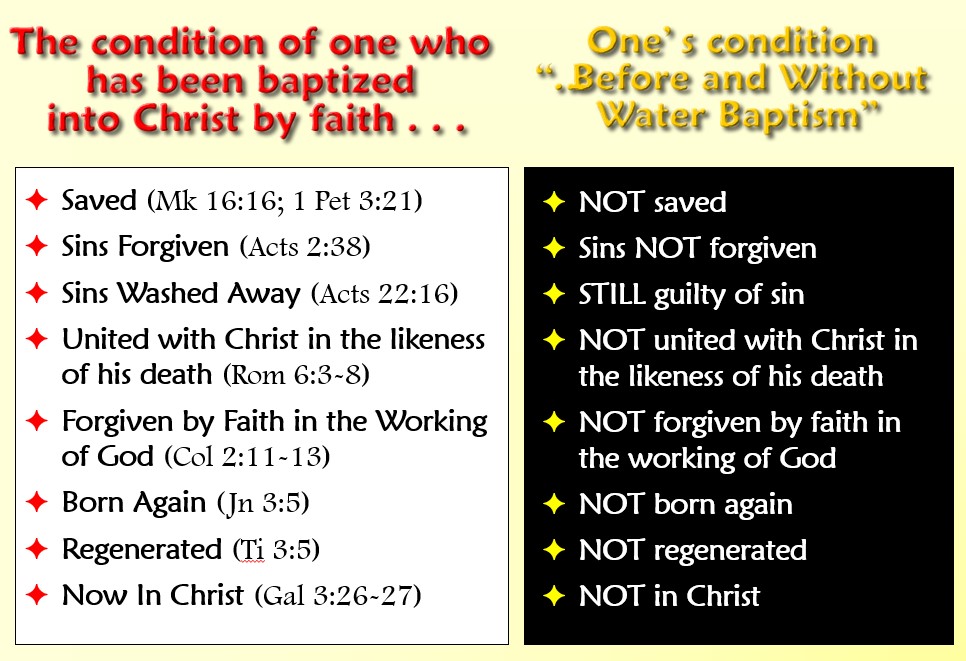
It’s a compelling chart. So, why do men declare that baptism does not save us?
T. Simmons, a prominent Protestant theologian, writes:
“…only saved people are to be baptized. We are not to baptize people in order to save them, nor because they want to be saved, but only because they are already saved” (A Systematic Study of Bible Doctrine, T. Simmons, Ch. 31; emphasis added).
The purpose of baptism has been redefined. Instead of teaching what the scriptures teach, men who teach the Protestant doctrine of “salvation by faith alone” have declared baptism to be merely a public display of the salvation one has already received by faith. It is said to be merely an outward show, a symbolic representation only. Baptism has been redefined as an important but optional act to be performed after one is saved.
Here are two examples of this teaching:
“We believe Baptism signifies entrance into the household of faith, and is a symbol of repentance and inner cleansing from sin, a representation of the new birth in Christ Jesus and a mark of Christian discipleship.” (The Book of Discipline of The United Methodist Church, Article VI — The Sacraments, 2016, emphasis added)
“Baptism serves as our confession before men, in as much as it is a mark by which we openly declare that we wish to be ranked among the people of God, by which we testify that we concur with all Christians in the worship of one God, and in one religion; by which, in short, we publicly assert our faith…” (John Calvin, Institutes of the Christian Religion, Book 4.15.1; emphasis added).
Why do these men make these declarations? Where do the scriptures ever say that the purpose of baptism is to be a symbol, a mark, a representation, a testimony, or a public assertion that one is already saved? Where does the Bible use any of those words to describe the purpose of baptism?
Instead, God says “baptism now saves us” (1 Pet 3:21). God says baptism is “for the forgiveness of sins” (Acts 2:38). God says that in baptism we “die with Christ” and are “set free from sin” (Rom 6:7-8). God says we are “baptized into Christ” (Gal 3:27).
The invented idea that baptism is MERELY symbolic puts church leaders in the unenviable position of flatly denying the truth of God.
Here is another vivid example. In reference to Peter’s statement that “baptism now saves us” (1 Pet 3:21), theologian John Winebrenner tells us what Peter really meant to say:
“Here the apostle does not mean to say that baptism does actually now save us, but that it does so formally, or declaratively” (The Ordinance of Baptism, 1868, p. 319).
According to Mr. Winebrenner, what Peter really means is that baptism formally declares that we’re already saved. Peter doesn’t mean that baptism actually saves us. Like many other theologians, Mr. Winebrenner has decided that Peter MUST mean something completely different than what he plainly says.
This is how error is spread. Winebrenner has made up his mind. So, he must twist the scriptures to fit his predetermined view.
Here is another astonishing statement. It is an open admission that in today’s churches baptism has a different purpose than it had in apostolic times:
“…in the Apostolic age when there was one Lord, one faith, one baptism, and no differing denominations existed, the baptism of a convert by the very act constituted him a member of the church,… In that sense, baptism was the door into the church. Now it is different… The churches, therefore, have candidates come before them, make their statement, give their ‘experience,’ and then their reception is decided by a vote of the members” (E.T. Hiscox, “Standard Manual for Baptist Churches” p. 22; emphasis added).
Who made the purpose of baptism different? Not God!
God’s purpose for baptism is the same today as it was in apostolic times. Baptism is for the forgiveness of sins (Acts 2:38). Baptism saves us (1 Pet 3:21). Baptism is the moment in time when we die with Christ, are set free from sin, and are raised with Christ to walk in newness of life (Rom 6:1-8). Baptism is the moment when Jesus saves us by his blood and adds us to his church (Acts 2:41, 47).
However, since the Reformation period in the 16th and 17th centuries the doctrine of “salvation by faith only” has distorted the Bible teaching on baptism. It is heart-breaking that many church leaders preach a different gospel than was delivered by Jesus and the apostles. I fear for them (Gal 1:6-9)
Please be concerned for church leaders who do not “speak as the oracles of God” (1 Pet 4:11). Teachers “will be judged with greater strictness” (Jas 3:1).
- They teach that one’s sins are forgiven BEFORE baptism. Yet Peter said, “Repent and be baptized every one of you in the name of Jesus Christ for the forgiveness of sins” (Acts 2:38). We should believe God over men.
- They bury the LIVING! They say we are made alive BEFORE baptism. Yet Paul says we are dead when we are baptized (Rom 6:1-8). He says we are buried with Christ into his death, and upon dying with Christ we are made alive and raised with Christ. This happens in baptism. We should believe God over men.
- They teach that we are already raised with Christ BEFORE baptism. Paul says we are raised with Christ IN BAPTISM (Col 2:11-13). We should believe God over men.
- They teach that one’s sins are washed away BEFORE baptism. Yet Ananias told Paul, “And now, why do you delay? Arise and be baptized and wash away your sins, calling on the name of the Lord” (Acts 22:16). We should believe God over men.
- They say baptism is just an outward SHOW. But Paul says that IN BAPTISM we die with Christ and are “set free from sin” (Rom 6:1-8). We should believe God over men.
- They teach that baptism is NOT necessary to be saved. Yet Jesus said, “He who believes and is baptized will be saved” (Mk 16:16). We should believe God over men.
It is a fearful thing to “distort the gospel of Christ” (Gal 1:7), for “we who teach will be judged with greater strictness” (Jas 3:1). Therefore, when we identify this error to our neighbor, we actually love him. Will you love your preacher/teacher/pastor? Will you give them an opportunity to hear the truth?
____________________________
8. The Conversion of the Philippian Jailer, Acts 16:25-34
The Philippian jailer asked the very question we are studying, “What must I do to be saved?” Paul’s and Silas’s simple answer is an excellent opportunity for us to learn how the scriptures use the word “believe” to summarize the entire response of one who hears and obeys the gospel. (For a detailed study of the word “believe” read the next article #6 “Believe Sums Up God’s Requirement for Salvation.”)
Paul and his co-worker Silas are in jail at Philippi for preaching about Jesus (Acts 16:25-29). While they are singing hymns at midnight an earthquake occurs and all the prisoners are loosed from their chains. The jailer decides to take his own life rather than face a certain punishment and death, but Paul assures him that all the prisoners are still there. Seeing that a powerful miracle has occurred, the jailer asks Paul and Silas, “Sirs, what must I do to be saved?” (v. 30).
Paul and Silas answer, “Believe in the Lord Jesus, and you will be saved, you and your household” (v. 31). The jailer invites Paul and Silas to his house and they speak the word of the Lord to everyone there (v. 32). In the same hour of the night the jailer and all his household are baptized (v. 33). Afterward, the jailer “rejoiced along with his entire household that he had believed in God” (v. 34). By asking and answering a few questions we can draw conclusions that are consistent with all the scriptures.
What did the jailer know about Jesus?
Had he been listening to Paul and Silas preaching and singing about Jesus? Possibly. Maybe he even knew about Jesus’ death, burial, and resurrection? But did he understand that he was a sinner who deserved death and faced eternal separation from God? Did he understand why Jesus had to die? Not likely. If he was going to “believe in the Lord Jesus,” he would need to be taught the gospel (Rom 10:14).
Thus, Paul and Silas “spoke the word of the Lord to him and all who were in his house” (v. 32).
What was the gospel message Paul and Silas taught the jailer?
- We know the message had to include the fundamental facts of the gospel, the matters “of first importance,” that “Christ died for our sins in accordance with the Scriptures, that he was buried, that he was raised on the third day in accordance with the Scriptures” (1 Corinthians 15:1-4), and that “God has made him both Lord and Christ” (Acts 2:36). One must believe those facts about Jesus to be saved.
- We also know they taught about repentance and baptism, because the text says “he was baptized at once, he and all his family” (v. 33). From the very beginning the gospel message included the command to “repent, and be baptized every one of you in the name of Jesus Christ for the forgiveness of your sins” (Acts 2:38). Paul and Silas issued these same commands to the jailer.
Why did the jailer and his household get baptized immediately?
The jailer and his family responded right away, “in the same hour of the night” (v. 33). Remember, this same urgency occurred in Acts 2, when 3000 people were baptized immediately upon hearing Peter’s gospel commands (Acts 2:37-41).
This same urgency also occurred when Ananias spoke to Saul “And now why are you waiting? Arise and be baptized, and wash away your sins, calling on the name of the Lord” (Acts 22:16).
Likewise, this same urgency occurred when the Ethiopian treasurer said, “See, here is water! What prevents me from being baptized?” (Acts 8:35-39).
All conversion stories in the book of Acts demonstrate a remarkable pattern of an immediate response to the gospel. We can understand the urgency of baptism when we understand its purpose. “Whoever believes and is baptized will be saved” (Mk 16:16). “Repent and be baptized… for the forgiveness of sins” (Acts 2:38). “Arise and be baptized, and wash away your sins (Acts 22:16).
After the jailer and his family were baptized, the text says he rejoiced that he had believed.
Acts 16:34 (ESV) 34 Then he brought them up into his house and set food before them. And he rejoiced along with his entire household that he had believed in God.
The jailer “had believed in God.” The word “believe” sums up the jailer’s entire response to the gospel. He was saved by his faith when he did what God said to do to be saved. After he obeyed the gospel “he rejoiced.” The scriptures are consistent. The jailer believed in the Lord Jesus when he repented and obeyed the gospel in baptism. As Peter says, “baptism now saves us” (1 Peter 3:21).
____________________________
9. What About the Thief on the Cross? Luke 23:39-43
Luke 23:39-43 (ESV) 39One of the criminals who were hanged railed at him, saying, “Are you not the Christ? Save yourself and us!” 40But the other rebuked him, saying, “Do you not fear God, since you are under the same sentence of condemnation? 41And we indeed justly, for we are receiving the due reward of our deeds; but this man has done nothing wrong.” 42And he said, “Jesus, remember me when you come into your kingdom.” 43And he said to him, “Truly, I say to you, today you will be with me in paradise.”
Jesus’ dying words to a dying criminal are some of the most amazing words ever spoken. The thief had lived a sinful life and was about to die in sin and perish for all eternity. Even as Jesus is undergoing the cruelest of punishments for the sins of every person who ever lived or ever will live, he sees the thief’s despairing condition, he sees his repentant heart, and he promises to save him. Amazing grace!
We are all that thief. Unfortunately, church leaders will misuse this beautiful and gracious event to argue that water baptism must NOT be necessary for salvation because the thief on the cross was saved without being baptized. Here is my question to them:
Why are you intentionally overlooking three obvious truths about this story?
FACT #1: THE THIEF WAS SAVED UNDER THE OLD COVENANT. Ponder that truth. Only after Jesus died and arose did the New Covenant conditions of salvation go into effect. Therefore, how the thief was saved under the Old Covenant has no bearing on how we are saved under the New Covenant. The thief was never commanded to “repent and be baptized in the name of Jesus Christ for the forgiveness of sins” (Acts 2:38). The New Covenant commands did not even apply to the thief. He lived under the Old Covenant. So, how the thief was saved proves nothing.
Honestly, how can one in good faith use the thief on the cross to change the gospel plan of salvation taught by Jesus and his apostles under the New Covenant?
FACT #2: JESUS HAD AUTHORITY ON EARTH TO FORGIVE SINS.
Mark 2:10-11 (ESV) 10 But that you may know that the Son of Man has authority on earth to forgive sins”—he said to the paralytic— 11 “I say to you, rise, pick up your bed, and go home.”
On this fact alone, their argument fails. Jesus can save anyone he wants to save. Case closed. No more really needs to be said. Jesus is Lord. So how can one one honestly use the thief on the cross to change the gospel plan of salvation taught by Jesus and his apostles?
FACT #3: NO ONE KNOWS IF THE THIEF WAS BAPTIZED OR NOT. We shouldn’t make arguments based on what we don’t know. Does anyone know if the thief was baptized with John’s baptism? What if he had been? Maybe Jesus knew. But it doesn’t matter. The story of the thief is irrelevant in determining the commands of the gospel under the New Covenant.
Here’s an additional point to consider about John’s baptism.
Acts 19:1-8 shows us that those who were baptized with John’s baptism had to be re-baptized in the name of Jesus. That’s because to be saved under the New Covenant and receive the gift of the Holy Spirit, believers in Jesus (that’s us today) have to die with Christ in baptism. We have to repent and be baptized in the name of Jesus to receive the forgiveness of sins and the gift of the Holy Spirit (Acts 2:38). So, even if the thief was baptized with John’s baptism, his baptism would be irrelevant in determining God’s plan of salvation under the New Covenant.
Do you understand why, based on these three important truths, people should stop using the thief on the cross argument to deny the necessity of baptism for salvation? The thief on the cross is a bad argument. Whether or not the thief was baptized is irrelevant.
LET’S DO A QUICK REVIEW:
After Jesus arose from the dead he issued EVERY condition for salvation (Mt 28:18-20; Mk 16:15-16; Lk 24:46-47). One must believe, repent, and be baptized to be saved.
These same commands were preached by Peter, Paul, Philip the evangelist, and the prophet Ananias (Acts 2:36-41; 8:35-38; 22:16; 1 Pet 3:21; Rom 6:3-8).
The apostle Paul warned us, on fear of condemnation, not to change the gospel (Gal 1:6-9).
With those truths in mind, I am challenging you to “test the spirits to see if they are from God, for many false prophets have gone out into the world” (I Jn 4:1).
- Read Acts 2:36-41 and ask yourself if baptism is necessary for the forgiveness of sins? (Then ask your church leaders what they teach.)
- Read Acts 22:16 and ask yourself if Saul of Tarsus was told that baptism was necessary to cleanse him of his sins? (Then ask your church leaders what they teach.)
- Read 1 Peter 3:21 and ask yourself if Peter taught that baptism saves people? (Then ask your church leaders what they teach.)
Please ask your church leaders, “What must I do to be saved?” If they tell you, “receive Jesus into your heart” or “say the Sinner’s Prayer” or “trust Jesus as your personal Savior,” you know they are teaching a false gospel. Anyone who refuses to give Peter’s answer in Acts 2:38, “Repent and be baptized every one of you in the name of Jesus Christ for the forgiveness of sins,” is teaching a false gospel.
____________________________
10. The Gospel Plan of Salvation: From God or Men?
What must I do to be saved? The Holy Spirit presents the gospel in simple terms. In the final article of this series, I am asking you to decide whether you will believe God or men. Will you stand with God?
WHAT HAVE WE LEARNED?
To believe in Jesus is to believe the facts of the gospel. Jesus died for your sins, was buried, and was raised from the dead, according to the scriptures. Jesus is both Lord and Christ (1 Cor 15:1-4; Acts 2:36).
To believe in Jesus is to obey the commands of the gospel. Peter commanded the Jews on Pentecost to “repent and be baptized… for the forgiveness of sins“ (Acts 2:37-38); Ananias commanded the apostle Paul to “arise and be baptized, and wash away your sins, calling on the name of the Lord” (Acts 22:16); Jesus said “whoever believes and is baptized will be saved“ (Mk 16:16); Paul said we are “baptized into Christ” (Gal 3:27). Only when you believe in Jesus, repent of your sins, and die with Christ in baptism, have you obeyed the gospel.
To believe in Jesus is to receive the promises of the gospel. When you hear the gospel message and obey it, God keeps his promise to forgive your sins and give you the gift of the Holy Spirit (Acts 2:37-41). God keeps his promise to raise you up with Christ to walk in newness of life (Rom 6:3-8). You are now born again of water and the Spirit (Jn 3:5). Paul says, “having been buried with him in baptism, in which you were also raised with him through faith in the powerful working of God” (Col 2:12). God powerfully works in baptism. He is faithful to keep his word.
God made the gospel simple to understand. The question is, will you believe God or men?
Throughout this series we have contrasted the true gospel with the false doctrine of “salvation by faith only” which came out of the Protestant Reformation over 500 years ago. See the article on Faith and Works. We have demonstrated that most church leaders today flatly deny the truth that baptism saves us. They deny that baptism is part of the gospel. You decide who to believe.
It is thought-provoking to contrast what the “faith only” preachers say with what Paul says in Romans 6:
- Faith only preachers say we are alive before baptism (they bury the living!). Paul says we are dead in sin when we are buried and raised with Christ IN BAPTISM. I believe God over men.
- Faith only preachers say we are already raised with Christ before baptism. Paul says we are raised with Christ IN BAPTISM. I believe God over men.
- Faith only preachers say baptism is just an outward show. Paul says we die to sin and are raised with Christ IN BAPTISM. I believe God over men.
Who will you believe?
- I believe Jesus: “whoever believes and is baptized will be saved” (Mk 16:16).
- I believe Peter: “be baptized in the name of Jesus Christ for the forgiveness of sins” (Acts 2:38).
- I believe the prophet Ananias: “arise and be baptized and wash away your sins, calling on the name of the Lord” (Acts 22:16).
- I believe Paul: “you were baptized into Christ” (Gal 3:27); “one who has died…has been set free from sin” (Rom 6:7).
Indeed, as Peter says, “baptism now saves us” (1 Pet 3:21). I believe the scriptures. We are not saved until we die with Christ and are raised with Christ. Baptism is not an outward show.
Romans 6:4 (ESV) 4 We were buried therefore with him by baptism into death, in order that, just as Christ was raised from the dead by the glory of the Father, we too might walk in newness of life.
Do you see how completely wrong it is to tell people they are saved before baptism? When men try to explain away or contradict the scriptures about baptism, they teach a false gospel.
That means you must make a choice. To believe God rather than men requires courage. It always has.
Do your homework. Ask the leaders of the church where you attend what you must do to be saved.
- Will they tell you what Peter told the Jews on Pentecost? Or will they tell you that baptism does not save you?
- Will they say you should be baptized later as an outward, symbolic show of the salvation you already have?
- Will they ignore the immediacy and urgency of baptism (Acts 2:41; 8:37; 10:48; 16:33-34; 22:16)?
- Do they make baptism into a monthly or quarterly ritual ceremony?
- Will they tell you to “receive Jesus into your heart,” or “pray the Sinner’s Prayer,” or “trust Jesus as your personal Savior”?
Ask them why they will not teach the gospel with the words Jesus and Peter and Paul used. True believers have always been called to take a stand for God’s truth versus the teachings of men (2 Tim 4:1-5). When false teachers tried to change the gospel in New Testament days the apostle Paul said, “to them we did not yield in submission even for a moment, so that the truth of the gospel might be preserved for you” (Gal 2:5). What will you do now that you are aware that men are teaching a false gospel?
Will you take a stand for the truth of the gospel? We are ready to stand with you if you choose to believe God. Please feel free to contact us if you have any questions or would like to learn more about God’s word.
– Jerry Crolius
_____________ Back to top of list